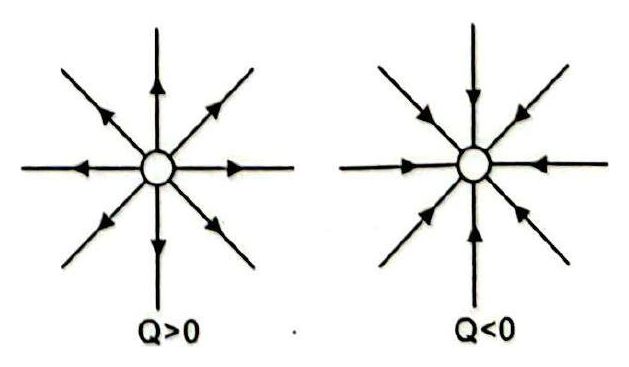
The electric field E due to a point charge at any point near it is defined as E=q→0limqF, where q is the test charge and F is the force acting on it. What is the physical significance of q→0lim in this expression? Draw the electric field lines of a point charge Q when (i) Q>0 and (ii) Q<0.
Solution
Physical significance: the test charge q must be so small that its own field does not alter the positions of the source charges; taking q→0 guarantees the measured field is that of the source alone. For Q>0 the field lines are straight lines directed radially outward; for Q<0 they are directed radially inward.