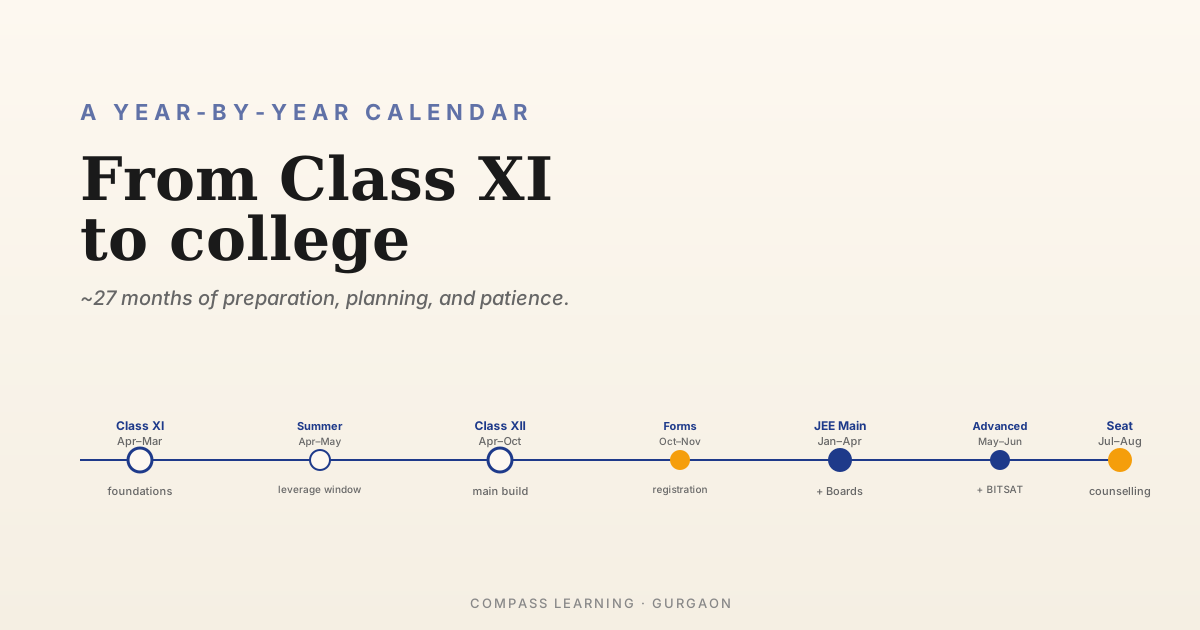
A student who walks into Class XI in April of a given year is, knowingly or unknowingly, beginning a journey that will end roughly two years and a few months later with a seat at an engineering college (or a deliberate detour into a drop year). The middle of that journey is intense — JEE Main, Boards, JEE Advanced, BITSAT, counselling all stack up between January and August of the second year. The beginning, in Class XI, feels nothing like that. It feels like school. But what happens in those early months shapes everything that comes later.
This article lays out a month-by-month and stage-by-stage calendar, from the start of Class XI through admission to college. It's evergreen — we've avoided specific dates — but the rhythms it describes are real and recurring.
The calendar is suggestive, not prescriptive. Every student is different. Read this as a frame, then adapt it to your child's actual situation.
Note: This article is written to be evergreen, but specific dates, fees, eligibility thresholds, and procedural details are set each year by the relevant authority — NTA, JoSAA, BITS Pilani, HSTES, or the institute concerned. Always cross-check the latest official notification before acting on anything time-sensitive.
One thing to keep in mind before we begin, because it shapes the whole calendar: JEE Main and JEE Advanced preparation do not happen one after the other. They run side by side. Main questions are easier in the sense that they involve fewer and less varied concepts and demand less analytical thinking. Advanced questions pull together multiple concepts, include some harder ones, and ask for deeper analysis — and a few chapters appear only in Advanced, no longer in the Main syllabus. So a student targeting only Main solves Main-level questions; a student targeting Advanced solves Main-level questions plus Advanced-level ones, all through. There is no "first finish Main, then start Advanced." Keep this picture in your head as you read.
Class XI — April to September: foundations
The first six months of Class XI are quiet, deceptively so. Boards are far away, JEE is more than a year away, and the school is mostly teaching Physics, Chemistry, and Mathematics from scratch. Most students don't yet feel the pull of competitive prep.
This is when the strongest students start their preparation in earnest. Not with frantic mock tests — there's nothing to test yet — but with slow, careful, basic-concept-focused, NCERT-grounded learning.
A reasonable pace:
- Physics — start with kinematics and mechanics. Study the fundamentals from NCERT or any solid basic book. Try to answer the theoretical questions about the concepts first; the heavy problem-solving can wait. Speed is not the goal; understanding is.
- Chemistry — Physical Chemistry alongside Mathematics is workable. Inorganic and Organic are usually started a little later, once the student is comfortable with the rhythm of two PCM tracks at once.
- Mathematics — Sets, relations, functions, basic trigonometry, basic coordinate geometry. NCERT first, then problems from a recognised JEE-level source.
The principle in this phase: build a foundation that doesn't crack later. A student who rushes through Class XI to "complete the syllabus" often finds in Class XII that gaps from a year ago are now blocking the harder problems they need to tackle.
Here's a mistake we see all the time. Many students start solving full-blown JEE questions from PYQ books right at the beginning — and then feel that their concepts are weak or their preparation is on the wrong track. The truth is simpler than that fear. School-level questions are mostly single-concept and ask for direct application. JEE Main questions are multi-concept. JEE Advanced questions are multi-concept and more analytical. So when a Class XI student, fresh into a chapter, picks up an actual Advanced-level problem and struggles, the problem isn't their understanding — it's that they've reached for a multi-concept, deeply analytical question before they've had the chance to build the concepts it sits on. Recognise that, and the discouragement disappears. Build the concept first; the hard questions become approachable in their own time.
A practical rule of thumb: most well-prepared students aim to have completed about 40–50% of the Class XI syllabus thoroughly by September of Class XI, with depth rather than coverage as the measure of "thoroughly".
Class XI — October to January: building competence
By October of Class XI, the student should have a few months of preparation behind them and a sense of how they learn. This is when consistency starts to matter more than intensity. The Class XI school year runs towards a final exam in late January or early February, so these months are the real build-up to that.
A reasonable pattern for this stretch:
- Continue the Class XI syllabus in PCM, aiming to complete it before the Class XI final exams.
- Start solving more JEE-level questions, including previous-year ones. By now they won't feel as intimidating, because the concepts underneath them are in place. A Main aspirant stays with Main-level questions; an Advanced aspirant adds the harder, multi-concept ones on top.
- Introduce a weekly test routine — one Physics, one Chemistry, one Mathematics test per week, roughly 60 minutes each, with problems from the chapters covered.
- Start mock papers in moderation — once a month, a full-length JEE Main / Advanced level mock paper covering the chapters done so far. Don't expect strong scores; the purpose is exposure, not performance.
- Keep a log of weak areas. Every test reveals topics that need revision. A simple notebook with chapter-wise notes on "what I keep getting wrong" is more useful than any prep book.
A word here about something most students get badly wrong: revision and memory. Revision builds memory, and a good memory is not a crutch — it is what lets you solve problems faster and with fewer silly errors. Many science students in India carry a false belief that memorising is somehow beneath them, that "real" intelligence means never having to remember. That's simply wrong. We all rely on memory every single day — imagine forgetting your own home address. Memorising the things that matter is not weakness; it's a necessity, and every sharp mind leans on a well-organised memory. (We've written about this at length, along with the other habits that separate strong preparation from weak — see Secrets of Success: How to Actually Study for JEE.)
Two things to be careful about during this phase:
The trap of moving on too fast. Schools, coaching institutes, and competitive peer groups can create pressure to "finish" the syllabus and rush into difficult books. Finishing without understanding is worse than not finishing — it's harder to undo later. Conceptual clarity, and holding on to those concepts, matters more than speed of coverage.
The trap of doing problems without learning theory. The opposite trap. Some students slip into a pattern of grinding problems without revisiting the underlying concepts. The strongest preparation alternates between the two, all the way through.
By the end of Class XI (around late January / early February), the goal is to have the full Class XI PCM syllabus completed at a comfortable JEE Main level — and for an Advanced aspirant, the Advanced-level work on those same chapters well under way — with weak areas identified and ready to revisit.
The February gap — after Class XI exams, before Class XII begins
Once the Class XI exams finish in late January or early February, there's a short gap before Class XII gets going in early March. Coaching institutes usually give a small break of a week or two; effectively the student gets roughly a month with no school and no Class XII pressure yet.
This is the first real chance to step back and see the whole JEE process clearly — with the full syllabus now in view, an honest sense of your own level, a clearer idea of what JEE actually demands, and a feel for how much your coaching is really helping. It's the moment to take control of your own learning rather than just following along. The most valuable thing you can do in this window is strengthen your Class XI portion:
- Revise Class XI thoroughly. A second pass — faster than the first, focused on the topics you flagged as weak. This is consolidation, not new ground.
- Plan a winning roadmap for the year ahead — one that builds memory, sharpens conceptual clarity, keeps your study efficient, cuts down errors, and pushes up your positive marks.
- Rest, properly. The next twelve months will be hard. A genuine break — a trip, family time, a hobby — is not a waste of time. Students who burn out later usually didn't rest when they had the chance.
Class XII — March to October: the final build
Class XII begins in early March, and this is when the dual demands begin in full: completing the Class XII syllabus, revising Class XI, and preparing for JEE Main and Advanced together. The school's pace, the coaching's pace, and the student's own internal pace all need to align — or at least not fight each other — during this stretch.
The target to hold in mind: by October, every serious JEE student should have finished the syllabus. After October, a different mode switches on — exam mode — where the focus shifts to revision, tests, and mocks. So the theoretical, foundation-building work should be done by October.
A workable structure:
Give the major part of your time to the Class XII syllabus, but always keep a slice for Class XI revision. If you can, set aside one full day a week for revision of both XI and XII. Make it a ritual — call it REVISION SUNDAY, and on that day do nothing else, just revise. This single habit pays enormous dividends later: fewer silly mistakes, more speed, better problem-solving overall.
The single biggest mistake we see in this phase: studying with constant input and no output. Reading textbook chapters all day, but rarely solving problems independently. Without independent problem-solving, the input never consolidates into real ability.
And a trap that's grown bigger every year — the online-video trap. Students today have endless videos for every topic and every problem, and it's easy to feel that watching them is the same as learning. It isn't. There's a real difference in outcome between reading from a book and solving with your own hand, versus passively watching a video. When you read and write, you think hard and process the information deeply, which builds genuine understanding and lasting memory. When you only watch, you mostly just nod along — "yes, that's correct" — without the deeper effort that makes it stick. The same shallow habit hides inside reading solutions instead of solving problems: you feel you've understood, but there's no guarantee you can reproduce it on your own. Studying by reading solutions, like studying by watching solution videos, is a risky business. (More on building the right study habits in Secrets of Success: How to Actually Study for JEE.)
A reasonable target for this stretch: the Class XII syllabus mostly covered by October–November, with a thorough revision of both Class XI and XII running alongside — weekly tests, part tests, and full tests all part of the routine.
By around the 25th of December, a student should aim to write one mock paper a day, right up until about a week before the JEE Main exam. In that final week, study no new source. And in the last three days — no tests, no heavy study. Only light revision and rest.
Around September–October of Class XII: the form-filling moment
JEE Main Session 1 registration usually opens around November or December. This is the first moment when the abstract goal of JEE becomes a concrete administrative action — and it arrives well before the board exams, while the student is still deep in coaching.
Things that happen in this window:
- Document collection. Photographs, signature scans, ID, marksheets, category certificate if applicable. (See our JEE Main and Engineering Entrance Documents: The Complete Checklist.)
- Form filling. A careful 30–45 minutes spent without rushing. (See our How to Fill the JEE Main Application Form: A Step-by-Step Guide.)
- Slot allocation. NTA assigns an exam centre and dates based on preferences.
This is also when parents, who may have been at a distance from the prep, become actively involved. Forms get filled together. Documents get verified. The exam-day plan takes shape.
Class XII — November to January: revision and mocks
The weeks before JEE Main Session 1 are the highest-leverage time for revision. Everything learned over the past year and a half gets consolidated, refined, and tested.
A common pattern:
- One full-length JEE Main mock test every 5–7 days at first, increasing in frequency as the exam approaches — building towards the one-a-day rhythm from late December.
- Detailed mock analysis after each. Not just "I got X marks", but "I made these specific kinds of mistakes". The mistake patterns are more useful than the score.
- Revision of the syllabus in waves. Two passes through PCM, with weak topics revisited more carefully.
- Sample papers from previous years. Past JEE papers are the closest thing to the real thing.
Boards revision begins quietly in parallel. Most students keep Boards-focused revision to about 20% of their study time during this stretch — enough to keep the school curriculum fresh, not enough to interfere with JEE prep.
February: JEE Main Session 1, then Boards begin
JEE Main Session 1 typically happens in late January or early February. A few days of intense focus, the exam, and then the recovery.
Soon after Session 1, Class XII Board exam preparation moves to the front. Most boards conduct exams from around mid-February into late March.
This is one of the most demanding stretches of a student's life — the JEE result lands in the middle of the Boards, and the mood from one feeds straight into the other. A few small principles for getting through:
- Don't post-mortem JEE Main Session 1 endlessly. The score is the score. Take what's useful from it, but don't carry the disappointment — or the false confidence — into Boards prep.
- Take Boards seriously. A 75%+ aggregate in Class XII is the eligibility threshold for JoSAA seat allocation — so doing well in Boards is functionally important, not just academically.
- Sleep. Stress-induced insomnia can derail this stretch. If sleep becomes a problem, treat it as a problem to solve.
March–April: Boards, then JEE Main Session 2
Boards typically wrap up by late March or early April, and JEE Main Session 2 happens in April — sometimes overlapping with the last few Board exams. The schedule is tight but workable.
A student who attempted Session 1 has the weeks between sessions to:
- Address weaknesses revealed in Session 1.
- Take 2–3 additional mocks.
- Apply for other entrance exams whose forms are open by now — BITSAT, VITEEE, state CETs.
Session 2 results come within a couple of weeks of the exam. The better of the two session scores is used for the final rank.
April–May: the final Advanced push
Students who qualify for JEE Advanced (the top ~2.5 lakh from JEE Main) have roughly a month between Main Session 2 results and JEE Advanced.
This is not where Advanced preparation begins — by now an Advanced aspirant has been working on Advanced-level problems all through Class XI and XII, alongside the Main work. This month is the final, concentrated push: switching the bulk of practice from Main-level (volume, accuracy, speed) to Advanced-level sources (depth, multi-concept problems, multi-step reasoning).
The month is short, but it's one of the most intense and rewarding stretches of the whole journey. A student who's done Class XI and XII well, and practised previous years' papers properly, already has the foundation. This month is about applying it to harder problems.
May–June: Advanced, BITSAT, state CETs
The peak exam season. JEE Advanced, BITSAT (two sessions, May and June), VITEEE, state CETs, university-specific tests — many students sit for 3–5 exams in this window.
Energy management matters here. Students who attempt every exam with full focus tend to do better than those who treat their backups casually. Each exam is its own performance.
June onwards: counselling
JEE Advanced result. JEE Main final rank list. Then JoSAA counselling, the BITS admission process, state counsellings, private university admissions — all in parallel.
The work shifts from preparation to decision-making. (See JoSAA Counselling Process: How IIT, NIT and IIIT Seats Are Allocated and Understanding Cutoffs and Closing Ranks.)
July–August: the journey ends
By August, most students have a seat. Hostel arrangements, travel logistics, the move into college life take over. The journey that began with Kinematics in Class XI ends with a confirmation email from an institute.
What this calendar doesn't show
A few things this calendar can't capture, but which matter enormously:
- A student's individual learning pace. Some learn faster, some slower. The calendar assumes a roughly typical pace; adjust as needed.
- Health and wellbeing. A burnout in November is more costly than a slightly slower pace in October.
- The role of teachers, mentors, peers. A good teacher accelerates progress more than any calendar can.
- Setbacks. Illness, family events, exam-day glitches, a particularly demoralising mock result — these happen. The calendar holds; the student adapts.
A note for parents
If your child is in Class XI or about to enter it, the most useful things you can do over the next two years are usually quieter than you'd expect:
- Be available, not intrusive. Ask once a week, listen when they want to talk, don't drill them constantly.
- Manage logistics so they can focus on study. Books, transport, meals, coaching enrolment, form filling — these are real and time-consuming, and your handling them frees the student.
- Help them rest. The pressure to study constantly is real; the deeper truth is that rested students perform better than exhausted ones.
- Plan for the form-filling and decision moments now, mentally. When Class XII rolls around and JEE Main registration opens, you'll know what to do.
Where to read next
For the bigger picture: JEE, BITSAT and Beyond: A Complete Guide to Engineering Admissions in India.
For how to actually study — memory, revision, source minimisation, the dos and don'ts: Secrets of Success: How to Actually Study for JEE.
For each major exam in detail: JEE Main Complete Guide, JEE Advanced Complete Guide, BITSAT Complete Guide.
For the counselling stage: JoSAA Counselling Process: How IIT, NIT and IIIT Seats Are Allocated.
For practical exam-day details: JEE Main Exam Day: What to Carry, What to Expect.
Have questions about your specific situation?
We're at Ardee City, Sector 52, Gurgaon. Drop by anytime, or give us a call. Always happy to chat through strategy with parents and students — no pitch, no pressure, just a conversation about what makes sense for you.